The CEMBooks team were delighted to see the latest iteration of the NHS Opel Escalation Framework for 23-24 released in August this year.
This document outlines how Trusts are expected to report their current operational status and outline their escalation processes.
By using a standardised format it should make trust and regional oversight easier and provide visibility around opportunities for intervention and mutual aid throughout an ICS or region.
https://www.england.nhs.uk/wp-content/uploads/2023/08/PRN00551-opel-framework-2023-24-v1.pdf
Key Performance Indicators and Weightings
The construct of Key Performance Indicators, (KPIs) that are scored and weighted individually and then combined virtually to trigger different OPEL scores has been part of the CEMBooks DNA for a decade. CEMBooks also provides a means of capturing situational narrative to add context and meaning to situation reports (SitReps). We use push notification to send alerts/actions/tasks and monitor responses using messaging and our escalation engine.
We are pleased to see the evolution of the OPEL framework to align with our own interpretation of how best to report system KPIs and status.
At the basic level a manual CEMBooks SitRep can be built in around 1 hour and subsequently only takes 5 minutes to complete when live..
We offer a simple affordable solution for capturing situational awareness and the responses to it. The system improves safety and efficiency by widening geographical awareness and response and is ideal for the new OPEL escalation framework. The system has been built by clinicians with 50 years of continuing frontline service.
Automated Data Feeds
The requirement for organisations to develop the automation of data feeds to populate a SitRep, as stated in the new document is one that CEMBooks has been designed for. We offer an open API that is able to receive data from any trust data warehouse, EPR, or third party provider. CEMBooks is currently receiving data feeds from: Orcale Cerner, EMIS Symphony, trust data warehouses and Ambulance Trust databases.
Automated feeds create two advantages:
- The SitRep can be completed with a single click if fully automated or it reduces the time taken to complete even if only partially automated.
- Those data feeds will usually run continually in the background – say every 15 mins – Using the snapshot function in CEMBooks you can then see the data pattern throughout the day from every time point everyday with just a couple of clicks (https://youtu.be/oFCOejFKfRw?feature=shared)
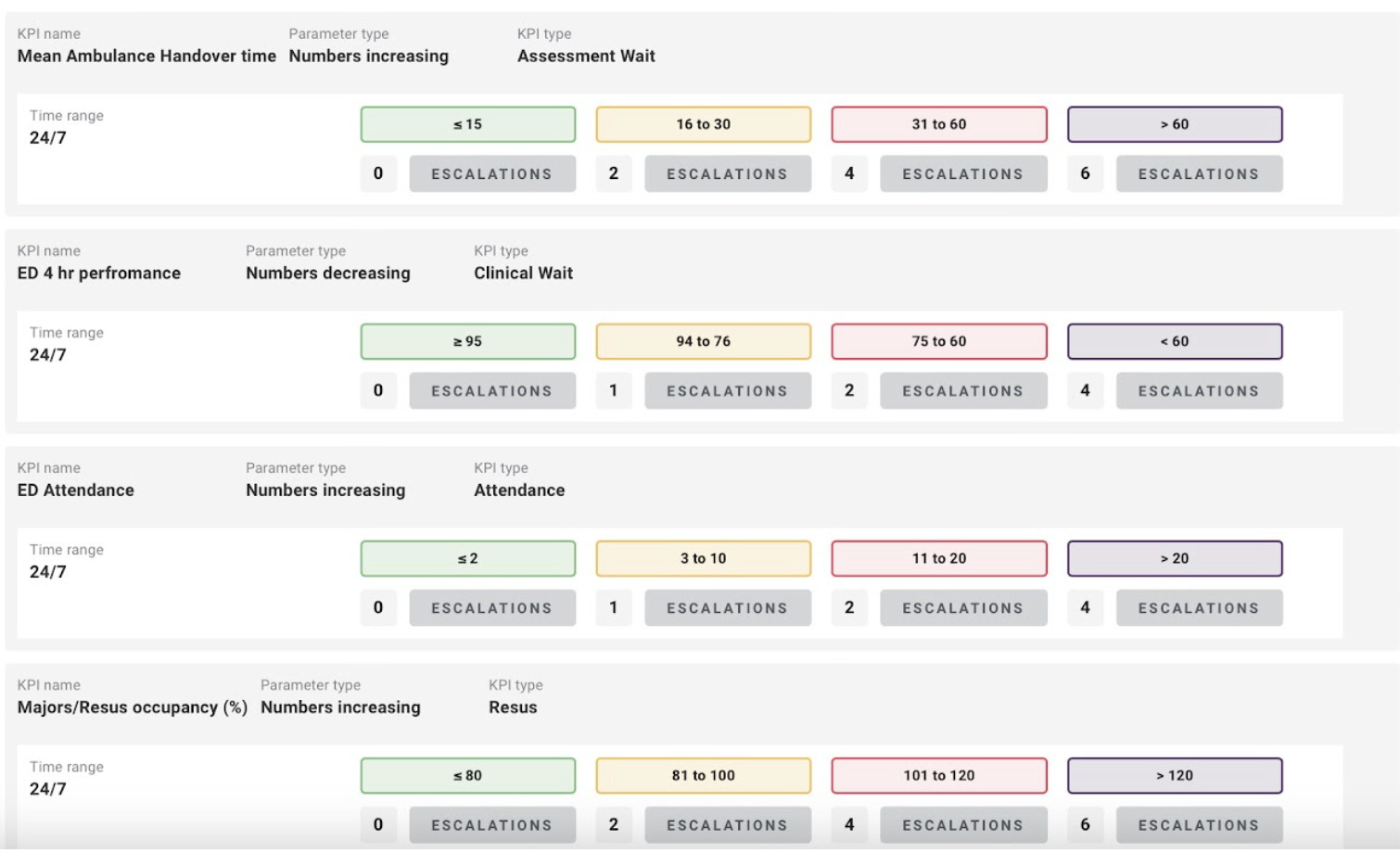
An example SITREP is illustrated below, showing how the KPIs can be set up, in this case, ‘number of patients attending the department’, with the appropriate numbers in line with the framework guidance, appropriate scoring, /weighting for this KPI, and then appropriate thresholds for the collection of KPIs for this acute hospital.
A SITREP such as this with manual input data can be set up in a matter of minutes to initially operationalise a Trust’s OPEL scoring framework.
Automating this, the CEMBooks API description can be provided, and from previous worked examples we can see that this takes around a day’s work to surface the JSON file to the CEMBooks API.
Escalations
As we dive deeper into the framework, the questions become, what do we do in response to a high OPEL score? Again, this is where CEMBooks can help. As part of the SITREP, role-based escalations for actions to be taken in response to certain situations can be included. Alternatively, CEMBooks’ task-based module allows outcomes from silver command meetings or bed meetings to be attributed for individuals to complete as part of tasks. And this can be tracked and monitored to see how things progress.
Once data has been surfaced to the CEMBooks API, usually on a 10 to 15 minute basis throughout the day, then the new feature ‘snapshot’ allows this data to be viewed hour by hour throughout the day so that trends can easily be identified and acted upon. Subsequently, if data is required for an investigation, at any point, it is extremely straightforward to revisit that date and to be able to examine the data, the narrative, and any tasks and escalations that were performed on that day.
If you’re looking for support with implementing the new NHS escalation framework or would like to improve your situational awareness across and department, trust ICS or region please contact us on our website.